Cost sharing (franchise, co-payment and hospital contribution) in health insurance explained simply

Health insurance is mandatory for everyone who is resident in Switzerland. This applies to Swiss citizens as well as to foreign nationals who live in Switzerland permanently.
Part of the Swiss system is that you contribute to your own healthcare costs. Both the franchise you can choose and the co-payment set by law are important parts of health insurance. They determine how much you, as the insured person, have to pay towards your medical costs yourself before the health insurer steps in.
Cost sharing at a glance
| Type | Your share |
|---|---|
| Franchise | Fixed amount of the medical costs you pay yourself, selectable between CHF 300 and CHF 2'500 (children and young people up to the age of 18 are exempt. Their ordinary franchise is CHF 0) |
| Co-payment | 10 % of the costs that exceed the franchise have to be paid by you. The annual maximum is: CHF 700 for adults and CHF 350 for children |
| Hospital contribution | CHF 15 per day Children up to the age of 18 and adults in education up to the age of 25 do not pay a hospital contribution. |
What is a franchise?
The franchise is the amount you have to pay yourself every year before your health insurance starts to cover benefits.
= cost sharing
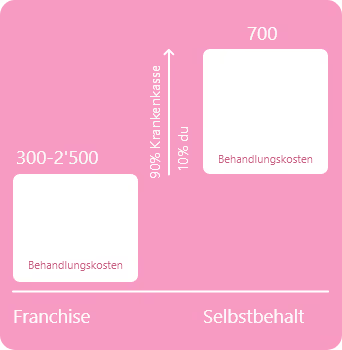
This means: you pay the treatment costs until you have reached the franchise you have chosen. After that you still pay a co-payment of 10 % of the costs. For adults the co-payment is a maximum of CHF 700. For children and young people the co-payment is a maximum of CHF 350. The remaining 90 % of the costs are paid by the health insurers. As soon as the maximum co-payment is reached, the health insurers pay 100 % from basic insurance.
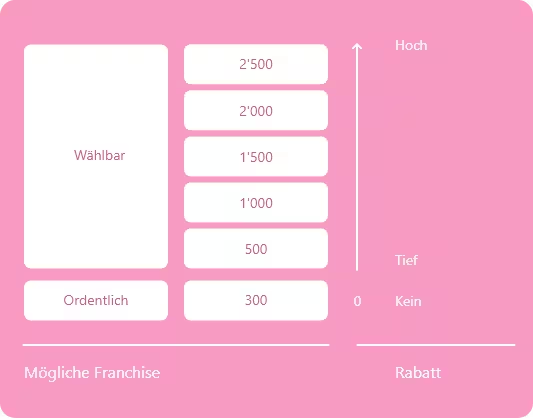
In basic insurance you can choose the amount of your franchise within the limits set by law.
The minimum franchise is CHF 300 per year, but higher franchises of up to CHF 2'500 can also be chosen.
The higher the franchise, the less you pay for your monthly premiums.
- Example:
If you choose a franchise of CHF 2'500, you first have to pay CHF 2'500 out of your own pocket in a calendar year before the insurance covers any further costs.
You can choose the following franchises:
| Adults | Children |
|---|---|
| CHF 300 (statutory minimum franchise for adults aged 19 and over) | CHF 0 (no annual franchise up to the age of 18) |
| CHF 500 | CHF 100 |
| CHF 1'000 | CHF 200 |
| CHF 1'500 | CHF 300 |
| CHF 2'000 | CHF 400 |
| CHF 2'500 | CHF 500 |
| CHF 600 |

Which franchise should I choose?
- When choosing the right franchise, you should consider your expected treatment costs and your financial situation. If you expect low costs, a high franchise makes more sense – and vice versa.
Our tip:
- To estimate your future treatment costs better, take a look at the tax statements from your health insurer. They list the treatment costs of the previous year.
If you choose a high franchise of CHF 2'500, you should be aware of the financial risk. In the worst case you have to pay up to CHF 3'200 out of your own pocket in one year (CHF 2'500 franchise plus the maximum co-payment of CHF 700). With a high franchise it is therefore worth setting this amount aside in a bank account – just in case.
Maximum treatment costs per year depending on the franchise
(adults)
| Annual franchise | Co-payment (max.) | Maximum amount per calendar year |
|---|---|---|
| CHF 300 | CHF 700 | CHF 1'000 |
| CHF 500 | CHF 700 | CHF 1'200 |
| CHF 1'000 | CHF 700 | CHF 1'700 |
| CHF 1'500 | CHF 700 | CHF 2'200 |
| CHF 2'000 | CHF 700 | CHF 2'700 |
| CHF 2'500 | CHF 700 | CHF 3'200 |

Can I change my franchise?
- Yes, you just have to observe the following deadlines and formalities:
Lowering the franchise:
- You can switch to a lower franchise at the start of a calendar year. You have to notify your health insurer of the lower franchise you want by the last working day in November.
Increasing the franchise:
- You can also choose a higher franchise at the start of a calendar year. You have to notify your health insurer of the higher franchise you want by the last working day in December.

What is the co-payment?
- The co-payment is the amount you have to pay on top of every invoice once you have reached the franchise. It is 10 % of the costs incurred, but no more than CHF 700 per year for adults and CHF 350 for children. This co-payment is independent of the amount of the franchise you have chosen.
For certain medicines the co-payment is 40 %. This applies when a medicine is too expensive compared with a
cheaper generic containing the same active ingredient.
Example:
- Once you have used up your franchise of CHF 2'500, you pay 10 % of the costs for further treatments and medicines yourself, until you reach the limit of CHF 700.
Combined example:
If your franchise is CHF 2'500 and you have medical costs of CHF 4'500:
- First you pay the CHF 2'500 franchise.
- Of the remaining CHF 2'000 you pay a co-payment of 10 %, i.e. CHF 200.
- Your health insurer covers the remaining CHF 1'800.
Calculation example based on the chosen franchise
Assumption: medical costs of CHF 4'500 per year
| Franchise | Co-payment (10 % of the remaining costs) | Your costs in total | Health insurer covers |
|---|---|---|---|
| CHF 300 | CHF 420 | CHF 720 | CHF 3'780 |
| CHF 500 | CHF 400 | CHF 900 | CHF 3'600 |
| CHF 1'000 | CHF 350 | CHF 1'350 | CHF 3'150 |
| CHF 1'500 | CHF 300 | CHF 1'800 | CHF 2'700 |
| CHF 2'000 | CHF 250 | CHF 2'250 | CHF 2'250 |
| CHF 2'500 | CHF 200 | CHF 2'700 | CHF 1'800 |
The co-payment is 10 %, a maximum of CHF 700 per calendar year (for children max. CHF 350).
Calculation example for children
Assumption: medical costs of CHF 4'500 per year
| Franchise | Co-payment (10 %, max. CHF 350) | Your costs in total | Health insurer covers |
|---|---|---|---|
| CHF 0 | CHF 350 | CHF 350 | CHF 4'150 |
For children the co-payment is 10 %, a maximum of CHF 350 per calendar year.
The statutory franchise for children is CHF 0. You can also choose a different franchise, but as a rule it does not pay off. Small children in particular need to see a doctor every now and then.
What matters for the health insurers' cost sharing is the year of treatment, not the invoice date.

What is the hospital contribution?
- If you stay in hospital, you have to contribute to the cost of meals in hospital. This contribution is called the hospital cost contribution. It is CHF 15 per day and is only due if you stay overnight in hospital.
Conclusion:
- The choice of franchise and the co-payment influence your annual healthcare spending and the amount of your monthly premiums. A higher franchise reduces the monthly costs, but increases the risk of higher out-of-pocket payments for medical expenses.