swiss flag Welcome to Switzerland

New to Switzerland — take out health insurance now.

In Switzerland, you are legally required to have health insurance — no later than 3 months after your arrival. alletta helps you find the right insurance provider digitally and independently.

Newly arrived couple checking health insurance options on a phone

Who is alletta for?

alletta is the right platform for newcomers with a residence permit.

Depending on your status, who can best help you with health insurance will vary.

Ideal for alletta

Residence permit category B or C

Category B
Annual stay:
You live and work in Switzerland for an extended period of time.
Category C
Settlement permit:
You are permanently settled in Switzerland.

alletta independently compares all health insurance funds and finds the right solution for you and your family.

Other contacts

For other situations

Seasonal workers (Cat. A):
It is best to discuss this with your employer.
Asylum seekers (Cat. N) & temporarily admitted persons (Cat. S):
Contact your municipality of residence.
Border crossers:
Contact health insurers directly (option: Switzerland or country of residence).
Seconded employees & diplomats:
You may be exempt from compulsory insurance — ask the canton.

Anyone who moves their residence from abroad to Switzerland and works here or receives a pension from Switzerland is required to have health insurance in Switzerland from day one. The deadline for taking out insurance is three months after registering with the residents' registration office.

First things first

3 months — that's your deadline

The clock starts ticking from the day you register with the residents' registration office. Here's what you need to know.

  1. 01

    Registration with the residents' registration office

    The 3-month period begins on the date your residence certificate or foreigner's identity card is issued. From this day on, you are already subject to compulsory insurance — even if you don't yet have a health insurance provider.

  2. 02

    Choose a health insurance provider — within 3 months

    You have 3 months to take out basic health insurance. Take it out as early as possible — so that you are covered immediately in case of illness and don't fall behind schedule.

  3. 03

    Insurance coverage applies retroactively from the date of entry.

    If you take out the policy within 3 months, your coverage applies retroactively from the day you take up residence. You also pay the premiums retroactively for this period.

Missed the deadline? If you register after 3 months, you're insured from that point onward — but not retroactively. You'll have to pay for any costs incurred during the uncovered period yourself. The health insurance company will also charge a penalty fee for the delay. So: the sooner, the better.

Each family member must be insured separately. In Switzerland, there is no family health insurance. Every person — adults and children — must take out their own health insurance and pays separate premiums.

The deadline is approaching — start now.

alletta finds the cheapest health insurance for your situation — digitally, independently, in just a few minutes.

Choose your health insurance now
Family arriving in a Swiss town

The Swiss system

Basic insurance and supplementary insurance — the difference.

The Swiss health insurance system has two pillars. The first is mandatory, the second voluntary — but both are important.

Mandatory for everyone

Basic health insurance (OKP)

Health Insurance Act (KVG)

  • Every health insurance company must accept you — regardless of age or health condition.
  • All health insurance funds offer identical services — the only difference is the price.
  • Covers: doctor's visits, hospital (general ward), medication, emergencies, maternity, vaccinations.
  • Premiums vary depending on the health insurance fund, canton, age, and chosen model.
  • You join with a deductible (CHF 300–2,500) and a co-payment (10% of the costs above the deductible).

No cashback at alletta (commission is legally capped). But: an independent comparison can save you up to an average of CHF 456 per year.

Voluntary

Supplementary insurance (VVG)

Insurance Contract Act (VVG)

  • Voluntary — you decide what additional insurance you want to have.
  • The insurer can require a health check and refuse in case of pre-existing conditions.
  • Covers: semi-private/private hospital rooms, free choice of hospital in Switzerland, dentist, glasses, complementary medicine, international treatment, and much more.
  • Services and prices vary greatly depending on the insurer and product.
  • Recommendation: sign up now while you are healthy — later the insurance company may refuse.

Cashback up to CHF 300 when taking out additional insurance through alletta.

Costs & Accident Protection

Deductible, excess and accident insurance — what applies to whom?

Deductibles and co-payments apply exclusively to basic health insurance. The higher the deductible, the lower the monthly premium — but the more you pay yourself in case of illness. The rules differ depending on age.

Franchise & Cost Sharing

Recommendation A — you go to the doctor regularly

CHF 300

You initially pay up to CHF 300 yourself, then the health insurance covers the rest. There's an additional 10% deductible on further costs — max. CHF 700/year. Maximum out-of-pocket expenses: CHF 1,000/year. Higher premium, but with reliable coverage.

Recommendation B — you are rarely sick

CHF 2,500

You pay more out of pocket, but save significantly on premiums — often CHF 100–200 less per month. This makes sense if you are young and healthy. Plan for a reserve of CHF 3,200 (maximum out-of-pocket expenses per year).

Intermediate levels (CHF 500 / 1,000 / 1,500 / 2,000): These usually offer little added value — the premium discount rarely justifies the additional cost risk. In practice, most people choose either CHF 300 or CHF 2,500.

Additionally: CHF 15 hospital contribution per day for inpatient stays. The deductible applies per calendar year and is reset on January 1st.

Accident coverage in the health insurance

✓ Exclude accident coverage — saves ~7–10%

If you are employed for 8+ hours/week

  • Your employer insures you against occupational and leisure accidents via UVG (Accident Insurance Act).
  • UVG = no co-payment, no deductible, including wage replacement in case of absence.
  • Excluding accident coverage from your health insurance → saves approximately 7–10% on your premium.
⚠ Include accident coverage — mandatory

If you don't work or work very little

  • Not employed, self-employed, or employed for < 8 hours/week.
  • Employed for less than 8 hours per week: only occupational accidents are covered, not leisure accidents.
  • Self-employed individuals: no accident insurance → include accident insurance in health insurance.
  • In case of job loss: 31 days of follow-up coverage via your former employer, then include accident coverage in your health insurance.

ℹ When starting a new job (8+ hours/week), exclude accident coverage from your health insurance — this is possible immediately and saves 7–10% on your premium. If you later lose your job or work less than 8 hours/week, reinstate accident coverage — report it to your health insurance company within 31 days.

Choose an insurance model — for all age groups

Primary care model (HMO / family doctor)

You should always contact your family doctor first. They will refer you to a specialist if necessary.

Savings: up to 20% cheaper than the standard model

Telemedicine model

You first call a telemedicine hotline. You receive immediate advice and are transferred if necessary.

Savings: up to 20% cheaper than the standard model

Standard model

Free choice of doctor throughout Switzerland, with no need to go through a family doctor or hotline. Most expensive option.

Full flexibility — highest premium

Tip: The deductible and plan can be adjusted annually on January 1st (notification required by the end of November). Combine a high deductible with a telemedicine or family doctor plan for the greatest premium savings.

Voluntary but recommended

Additional protection with supplementary insurance.

Many services that you might be familiar with from your home country are not included in Swiss basic health insurance, or only partially covered. Supplementary insurance is available for these services.

Hospital supplementary insurance

  • Semi-private: 2-bed room, free choice of attending doctor
  • Private: single room, free choice of doctor & hospital (CH)
  • Rooming-in for accompanying person

Outpatient supplementary insurance

  • Complementary medicine: osteopathy, homeopathy
  • Fitness contribution & prevention
  • Glasses & contact lenses (contribution)
  • Psychotherapy, medication without a prescription

Dental care insurance

  • Dental treatments (fillings, extractions)
  • Orthodontics / braces
  • Professional teeth cleaning

Abroad & travel

  • Extended coverage for treatments abroad
  • Repatriation from abroad
  • Especially important for the USA, Canada, Japan

Get your policy now — while you're healthy. Health insurance companies may require a health check for supplemental insurance. They can refuse coverage or exclude certain benefits if you have pre-existing conditions. Newcomers to Switzerland who haven't yet declared any pre-existing conditions now have the best chance of being accepted without reservations.

Preparation

You will need these documents.

To take out health insurance in Switzerland, you need two documents. Which identification document you need depends on whether you are a foreigner or a Swiss citizen.

Document 1

Proof of identity — depending on the situation

Foreigners — Immigration from abroad

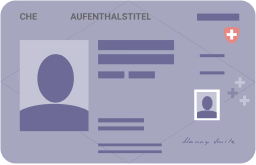
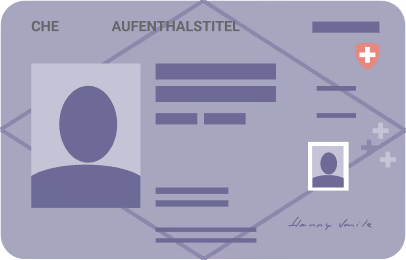
Swiss residence permit card (Aufenthaltstitel)

Residence permit (foreigner's identity card): the blue card, labeled Category B (annual residence permit) or Category C (permanent residence permit). Both are valid proof of identity.

Where to apply?

  • Apply at the residents' registration office of your municipality during registration.
  • The card is then issued by the cantonal migration office and delivered by post (approx. 2–6 weeks).
  • Haven't received your card yet? The municipality provides a temporary registration confirmation — this is sufficient for the interim period.

Swiss citizens — returning from abroad

Swiss passportSwiss identity card

Swiss citizens returning to Switzerland must prove their identity with a valid Swiss passport or Swiss identity card.

Passport expired?

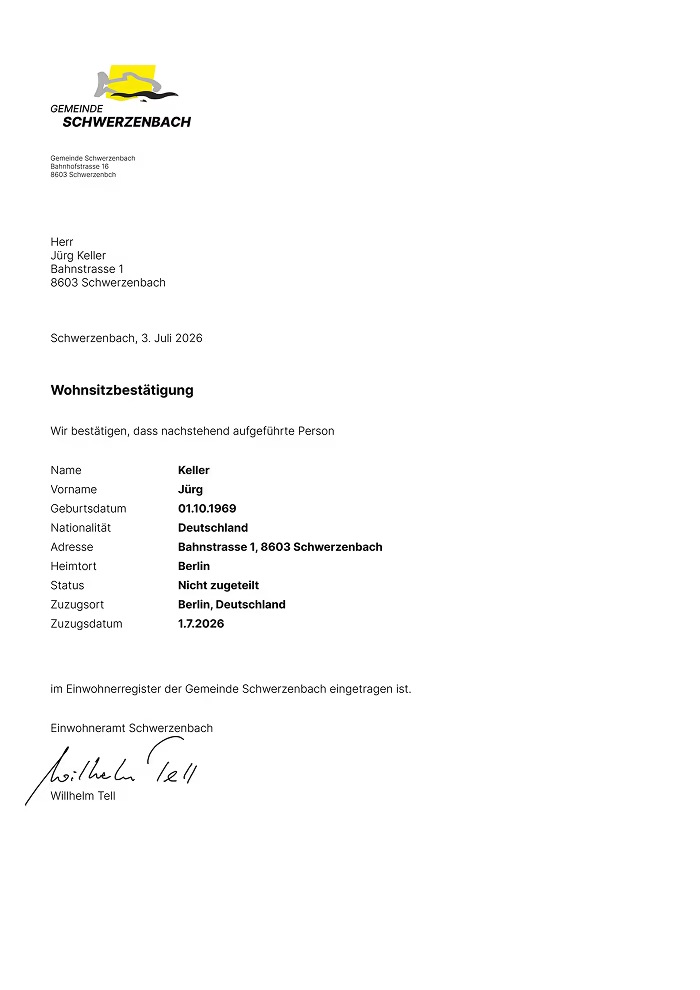
Sample confirmation of residence letter

Document 2 — for foreigners and Swiss citizens

Confirmation of residence

An official letter from your municipality of residence confirming when you registered in Switzerland. It documents the exact start date of your compulsory insurance and is equally relevant for foreigners and returning Swiss citizens.

Where can you get it?

  • Residents' registration office of your municipality — often available immediately upon registration.
  • Many municipalities allow online ordering via the municipal website.
  • Cost: CHF 0–30 depending on the municipality.

Find your municipality

Find the residents' registration office for your municipality — with address, website and contact details.

Search municipality

Supplementary insurance via alletta — and get up to CHF 300 back.

Because you're advising yourself, we'll pass on a portion of our commission to you. Unfortunately, this isn't possible with basic health insurance (commissions are legally capped) — but it is with supplemental insurance. More about cashback

Questions & Answers

Frequently asked questions from newcomers.

Ready? Find your health insurance provider now.

alletta guides you step by step — digitally, independently, and in German. Find the right insurance for you and your family in just a few minutes.

100% digital · independent · FINMA-registered · data hosted in Germany in compliance with the GDPR